


Cedar Peak Farmhouse
2,532 SF · 1 storey
Draw a slab, a walk, a patio or a driveway in the free 2D/3D editor and the estimate counts it: cubic yards of ready-mix concrete with waste, the crushed-stone base in tons and the reinforcement in pounds. No sign-up.
No sign-up needed to try
It works in your phone’s browser, nothing to install.
Type the slab’s length, width and thickness. The answer is what the estimate prints for that flat slab.
Mixing it yourself: about 86 bags of 80 lb or 115 bags of 60 lb, at the 0.6 and 0.45 cu ft printed on the bag, rounded up.
A flat slab of 144 SF. Footings, thickened edges and steps are not in it: draw them to count them.
Concrete flatwork from the catalog, a 12 by 12 ft square at 4 in., Calculate, and the estimate’s own rows. Every press is the editor’s own control.


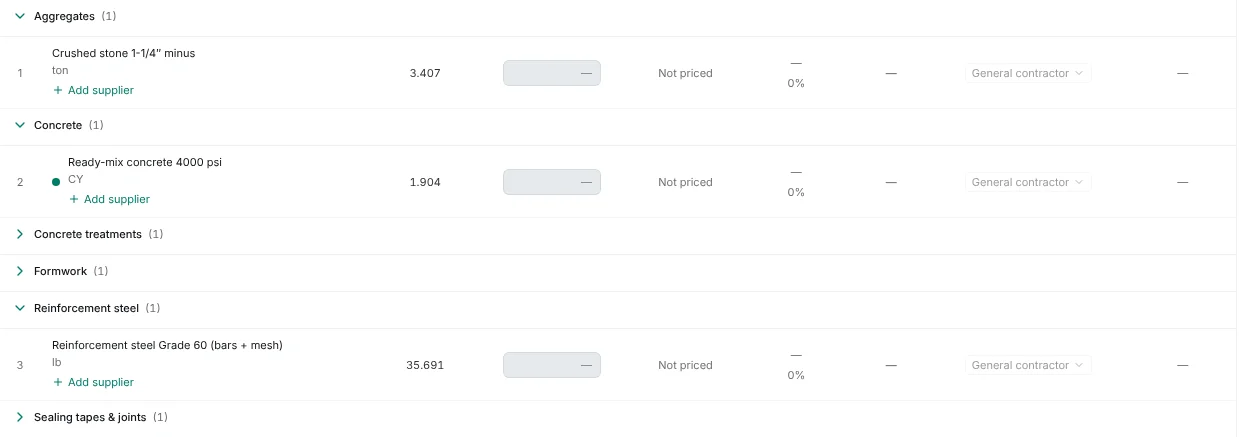
A slab you draw is measured as a solid: its length, its width and its thickness. The estimate lists the ready-mix concrete in cubic yards, the crushed-stone base under it in tons, the reinforcement steel in pounds, the edge forms in square feet, the expansion joint filler in linear feet and the curing compound in gallons. Make the slab thicker and the concrete follows; make it bigger and every row does. The sizes icon beside the concrete row turns its cubic yards into 10 CY trucks or 80 and 60 lb bags.
The same goes for a foundation slab, strip footings and pad footings: each is its own work in the Foundations section, and each prints its concrete in cubic yards from the shape you draw.
For each cubic yard of slab the catalog takes one cubic yard of ready-mix concrete and adds 7% for waste, spillage and an uneven subgrade, inside the 5 to 10% extra a concrete supplier asks you to order. Under it, the crushed-stone base is about 45 lb per square foot of slab with 5% added, and the reinforcement about 0.23 lb per square foot with 10% added, close to the weight of a 6 × 6 welded wire mesh.
Volume: length times width in feet times the thickness in inches divided by 12 gives cubic feet; divide by 27 for cubic yards. A 12 × 12 ft slab at 4 in. is 12 × 12 × 4 ÷ 12 = 48 cubic feet, which is 1.78 cubic yards, and 1.90 with 7% added.
Bags: a bag says how much concrete it makes, usually 0.60 cubic feet for 80 lb and 0.45 for 60 lb. Divide the cubic feet by that and round up: 1.90 cubic yards is 51.4 cubic feet, so 86 bags of 80 lb. The estimate prints cubic yards, and the sizes icon beside the concrete row does this division for 80 and 60 lb bags.
Open a gallery house as your own copy where its author allows it, press Calculate and look under Concrete.
You draw without an account and without installing anything. The slab is kept in this browser and comes back after a reload; it is not backed up anywhere else, the browser holds a single drawing, and Export JSON in the File menu saves it as a file for later.
A slab or a whole foundation drawn by hand is counted free. Builders on a subscription also get automatic layout of the roof and the house’s pipes, ducts and wiring, and one press that places a whole set of parts at once. See pricing.
Cubic yards, with waste. The sizes icon beside the row gives 80 and 60 lb bags and 10 CY trucks; by hand, divide the cubic feet by the yield printed on the bag.
Yes. Type the slab’s height when you add it, 4 in. or 6 in. or any other, and the concrete follows.
Yes. Strip footings, pad footings and a foundation slab are works of their own, each counted in cubic yards from what you draw.
From you: the catalog ships none, and you enter what you pay per cubic yard on the Materials tab.
No sign-up needed to try


